History and politics
Bangladesh's political history, and the institutions and movements that shaped it.
Political history · Constitution · Movements
The Policy Institute researches Bangladesh's politics, history, governance and public policy, trains people in research and leadership, and brings policymakers, politicians and activists together in dialogue.
Bangladesh does not yet have enough reliable data to base policy on. We collect it ourselves, analyze it, and share what it shows with the people who decide and the people who want to understand.
A Bangladesh where policy is driven by research and data, where evidence-based decision-making is the norm, not the exception, across governance, economics, and politics.
To strengthen governance and development outcomes through rigorous research, policy engagement, and capacity building.
Our work draws on experts from different disciplines, so every question is looked at from more than one angle.
We publish how our data was collected and how our conclusions were reached.
Where the numbers don't exist, we go to the field and collect them.
Our reports and courses are written to be understood by non-specialists.
We carry out our own research on Bangladesh's politics, history, governance and public policy, and share what we find through papers, reports and writing.
Bangladesh's political history, and the institutions and movements that shaped it.
How the state governs and is held to account, and how it makes decisions on the economy.
Bangladesh's place in the world: diplomacy, trade and relations with neighbors and major powers.
How literature reflects, records and shapes political and social change.
Access, quality and what students actually learn, including skills for the job market.
Electricity and fuel: the policy choices around supply, prices and the shift to cleaner sources.
More research areas will be added as the institute grows.
Formal studies that follow academic standards.
In-depth analysis of a policy question, with recommendations.
Short, plain-language writing for a wide readership.
Open to students, professionals, journalists, policymakers and anyone who wants a clear grounding in research, in how Bangladesh works, and in making good decisions.
বাংলাদেশের সংবিধান ও রাষ্ট্রকাঠামো
How the constitution works and how the state is organized: parliament, the executive, the judiciary, elections, the principles of state policy and fundamental rights. Taught in person in Dhaka, with classes taken by experts in the field.
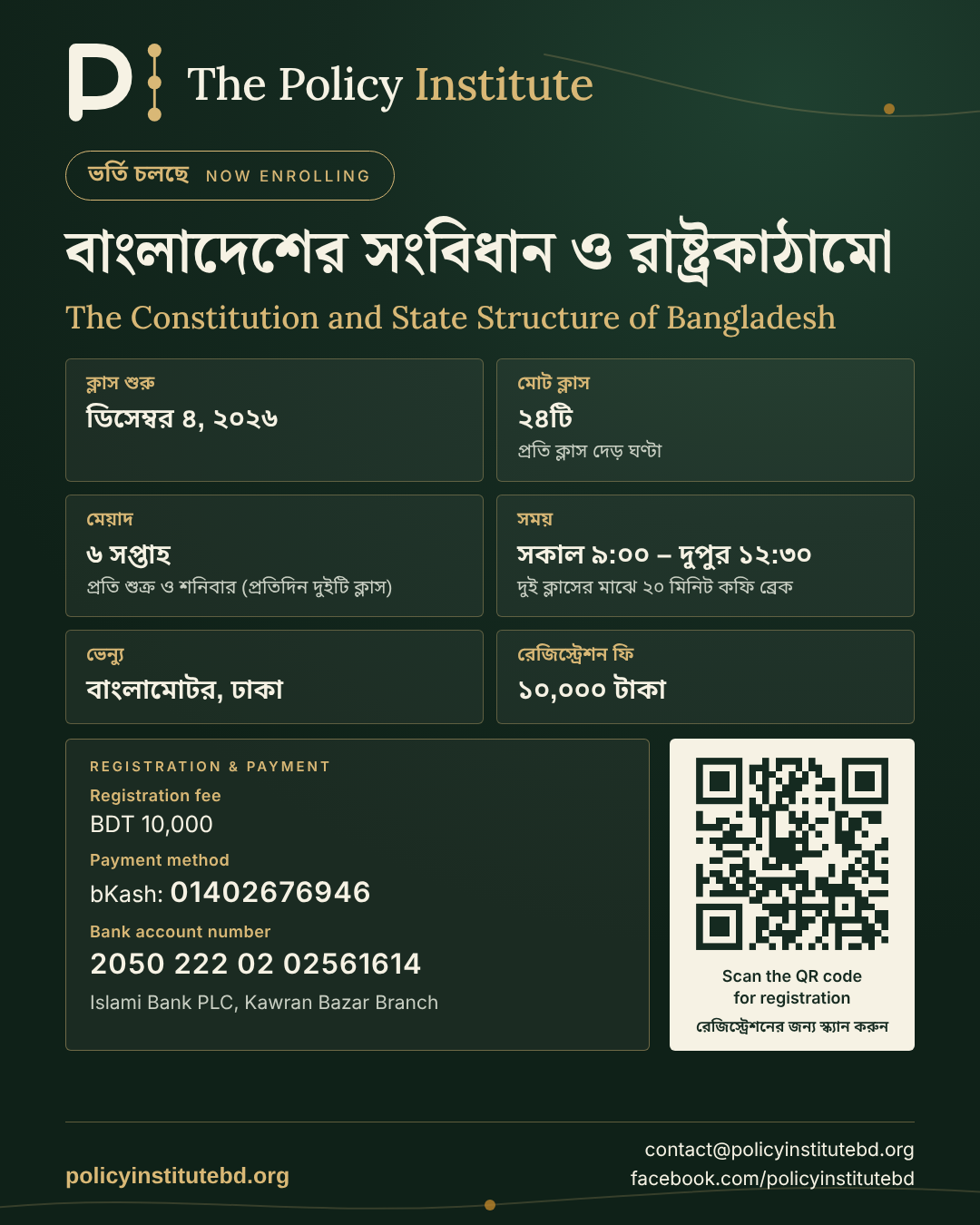
Download the flyer and share it with anyone who might want to join. It has a QR code that opens the registration form.
We also run one-off workshops. Other courses will open soon. To hear first, write to us at the address in the contact section.
We bring policymakers, politicians, activists, academics and civil society into the same conversation, so that policy and practice stop drifting apart.
Public talks and discussions on research findings and policy questions.
Structured conversations that bring policymakers, academics and civil society together on one issue, with evidence on the table.
A place where ideas move in both directions between researchers, officials and politicians.
Speechwriting, situation and project analysis, evidence and information gathering, and preparation for parliament, standing committees and campaigns.
Sessions and conversations that give young activists the evidence and skills to take part in policy debate.
Bringing the people who write policy and the people who live with it into the same conversation, so ideas are tested against reality.
The institute is led by its founder and works with a multidisciplinary team of experts across research, training and dialogue.

Assistant Professor of Economics at North South University, Dhaka. Applied economist with research experience in development, political economy and survey design, including survey implementation and election forecasting.
Write to us about a study, a course, a seminar or a speaking request. We reply to every message.
Dhaka, Bangladesh · Facebook